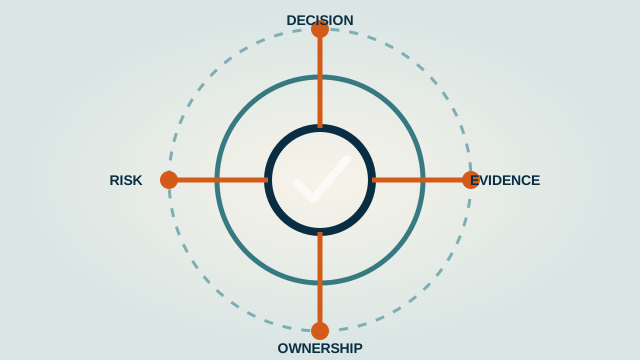
Good governance clarifies decisions, ownership, evidence, and escalation so organizations can move faster without losing control.
Governance Is a Decision System
When technology, cyber risk, regulation, AI, and business models change quickly, organizations often respond by adding committees, documents, approvals, and reporting. More activity can create the appearance of control while making accountability less clear.
A useful governance system answers a small number of questions consistently: What decision is being made? Who owns it? What evidence is required? Who must be consulted? What risk can be accepted? When must the issue be escalated? How will the outcome be monitored?
Clarify Decision Rights
Ambiguity creates delay and hidden risk. Teams wait for consensus, decisions migrate upward, or work proceeds without the right stakeholders because no one knows where authority sits.
Decision rights should distinguish approval, recommendation, consultation, execution, oversight, and assurance. The same person should not necessarily perform all six roles, but each role should be visible.
Use Proportional Risk Tiers
Not every change deserves the same level of review. A low-risk productivity tool and a system that changes customer data or financial decisions should not move through identical processes.
Risk tiers create speed by defining which factors increase scrutiny: sensitive data, customer impact, autonomy, financial authority, regulatory significance, external dependency, irreversibility, and potential harm. Teams can move quickly when the path is predictable.
Demand Evidence, Not Theater
Governance is strongest when evidence is built into the work: business cases, testing results, risk decisions, ownership, exceptions, monitoring, and closure. It is weakest when the organization produces polished presentations that cannot be traced to operating reality.
Boards and executives should receive fewer status narratives and more decision-ready information: the outcome, the remaining uncertainty, the tradeoffs, the accountable owner, the action required, and the evidence that will demonstrate completion.
Manage Governance Debt
Organizations accumulate governance debt when policies, committees, approvals, and reporting continue long after their purpose has changed. The result is duplicated oversight, conflicting direction, and work performed to satisfy process rather than improve a decision.
Governance should be reviewed like an operating model. Remove obsolete steps, consolidate forums, automate evidence, clarify thresholds, and measure cycle time. Better governance should increase both confidence and velocity.
What leaders should carry forward
- 01
Define decision rights and escalation before complexity arrives.
- 02
Use proportional risk tiers to apply the right depth of review.
- 03
Continuously remove governance debt and automate evidence.

Matthew March
Matthew March is a financial-services technology executive, board director, Fractional CISO, and adviser with more than 25 years of experience connecting technology strategy to growth, resilience, governance, and enterprise value.
Read Matthew’s Story