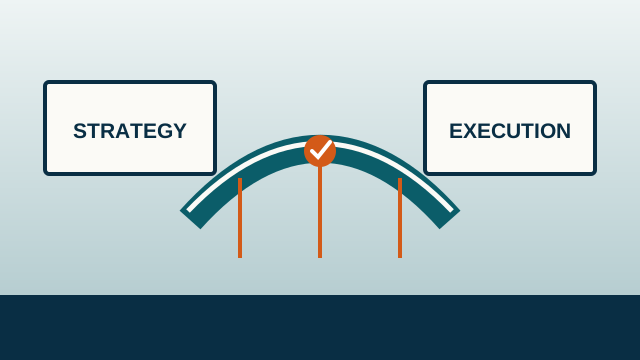
Growth becomes durable when the organization can increase volume, maintain control, preserve service, and make decisions without adding complexity at the same rate.
Growth Exposes the System
A growing organization can hide operating weaknesses for a period of time by adding people, manual controls, exceptions, spreadsheets, and management attention. Eventually, the work becomes too interconnected and the cost of coordination rises faster than the value created.
Sustainable growth requires a system that can absorb more customers, products, transactions, employees, partners, and regulatory expectations without losing clarity or control.
Build Capabilities, Not Departments
Customers experience end-to-end capabilities: onboarding, service, payments, lending, reporting, problem resolution. They do not experience the organizational chart.
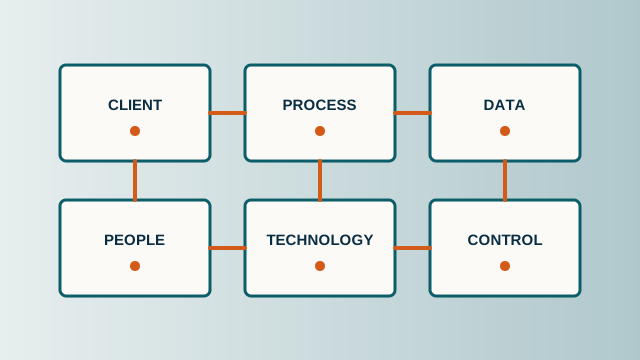
Leaders should map the people, process, data, technology, controls, and third parties required to deliver each critical capability. That view exposes handoffs, duplication, missing ownership, rekeying, and dependencies that departmental planning often misses.
Create Front-to-Back Ownership
When ownership stops at a functional boundary, problems move rather than resolve. Front-to-back ownership assigns accountability for the outcome across the journey, including adoption, service levels, exceptions, data quality, controls, and economic performance.
Cross-functional governance should support that owner with clear decisions and evidence—not replace ownership with collective ambiguity.
Standardize the Repeatable, Elevate the Exceptional
Scale depends on distinguishing repeatable work from judgment-intensive work. Standard workflows, common data, business rules, automation, and clear service levels should handle routine cases. Skilled employees should focus on exceptions, relationships, and decisions where judgment creates value.
Automation that merely accelerates an inconsistent process can increase risk. The process and decision model should be simplified before it is automated.
Measure Capacity and Control Together
An operating model should make it possible to see whether growth is creating leverage. Useful measures include unit cost, cycle time, first-time quality, exception volume, employee capacity, customer effort, control performance, incident frequency, and time-to-recovery.
The goal is not efficiency at the expense of resilience or control. It is an organization that can grow while preserving trust, service, accountability, and the ability to recover.
What leaders should carry forward
- 01
Design around end-to-end capabilities rather than functional silos.
- 02
Assign front-to-back ownership for outcomes, adoption, controls, and economics.
- 03
Measure operating leverage and control performance together.

Matthew March
Matthew March is a financial-services technology executive, board director, Fractional CISO, and adviser with more than 25 years of experience connecting technology strategy to growth, resilience, governance, and enterprise value.
Read Matthew’s Story